

I’ve been thinking about nuclear fusion lately, and the first installment in my explorations is an essay today in Quanta magazine. It riffs off the cold-fusion kerfuffle of the 1980s. At the risk of bringing down a deluge of hate mail from cold-fusion true believers, the experiments back then were a wild goose chase; many were downright fraudulent. More happily, though, there’s another phenomenon that goes by the name of “cold fusion”—the original meaning of the term, in fact—and is totally legit. I spoke to several physicists who work on it and couldn’t possibly fit everything I learned into the essay.
In the late 1940s English physicist Charles Frank and, in secret, Russian physicist Andrei Sakharov predicted a novel way to achieve nuclear fusion—one that is totally different from the process that powers the sun and fusion-energy reactors, not to mention the hydrogen bombs that Sakharov and his American opposite numbers were beginning to develop. The key is a particle that we now call the muon. It’s a close sibling of the electron and can stand in for it in an atom, creating what physicists dubbed an “exotic atom” with properties that fully justify that name—including an ability to circumvent barriers to fusion.
A decade later, oblivious to these predictions, Luis Alvarez and his colleagues at U.C. Berkeley stumbled on the process while doing unrelated experiments. Before his paper appeared in print, he announced it publicly and speculated about a bountiful new energy source, so the story has some parallels with the events of the 1980s, but at least Alvarez was a careful scientist. Journalists christened this technique “cold fusion.”
“It’s without doubt muon-catalyzed fusion exists,” said one of the physicists I talked to, Cătălina Curceanu at Italian National Institute for Nuclear Physics, just outside Rome. “The problem is whether the energy balance is positive.”
Normally what keeps two nuclei from fusing together is their electric charge. Being both positively charged, they repel each other. But because nuclei are not strictly little balls, but little waves—this is the essence of quantum physics—they can penetrate their electrical shielding, a bit like how a sound wave will propagate through a wall. Physicists refer to this process as quantum tunneling. The probability of it diminishes exponentially with the distance between the nuclei. For ordinary atoms, it’s effectively impossible. Even at the center of the sun, it happens only rarely, which is why the sun will shine for billions of years.
But if you could shrink the distance, you’d make tunneling feasible. That’s just what the muons do. A muon is 207 times as massive as an electron, and an atomic orbit is inversely proportional to the mass of the orbiting particles, so if you substitute one for an electron in an atom, the atoms will shrink as much as 207-fold. (The precise value depends on the how heavy the nucleus is.) It would be like shrinking Earth’s orbit until it touches the sun. “It’s all much more compact,” said Nancy Paul at the Kastler-Brossel Laboratory in Paris. If you pull this trick on a hydrogen molecule, it will bring the two hydrogen nuclei right up against each other and they will fuse almost instantly.
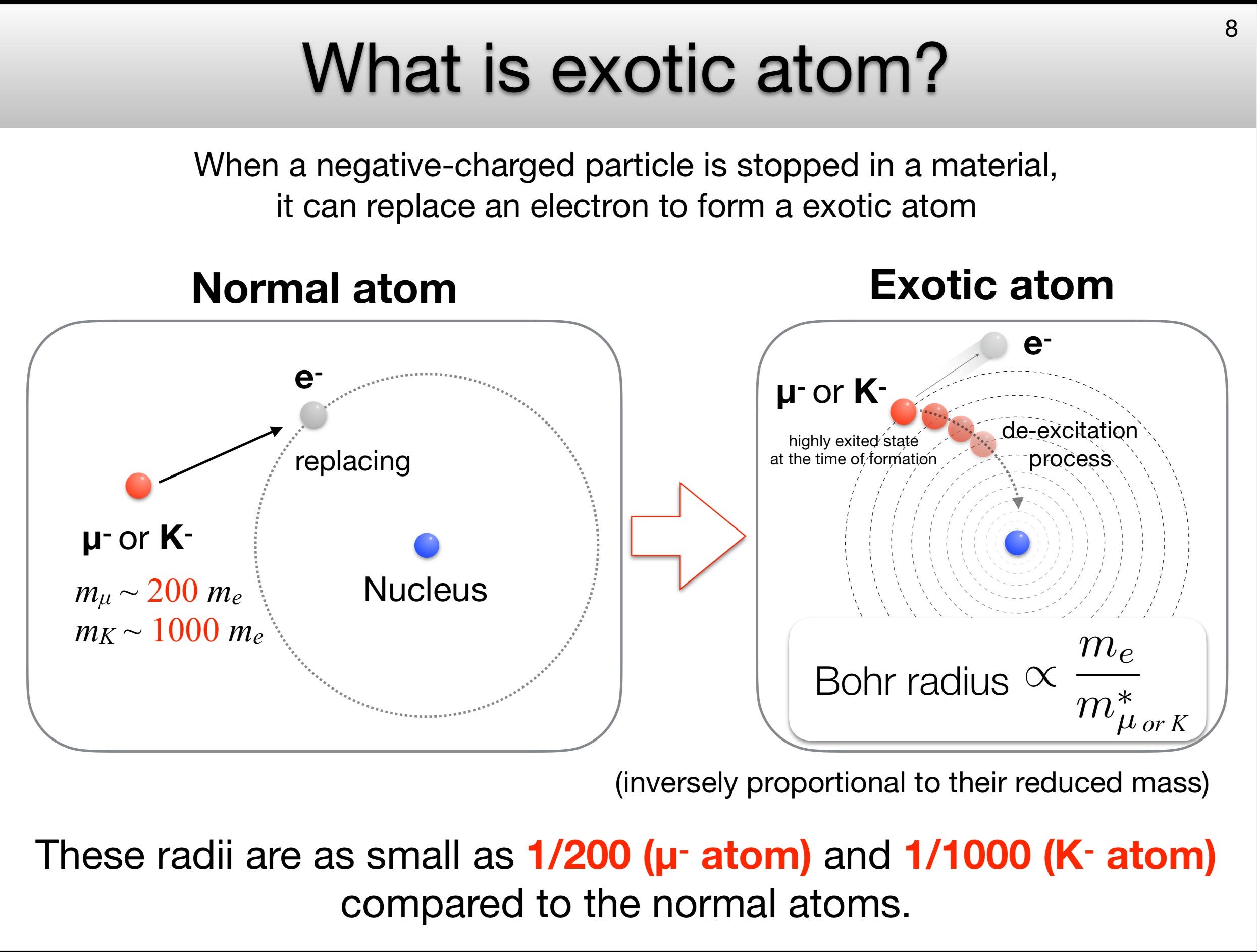
Shinji Okada at Chubu University in Japan took the time one morning to map out the procedure for me. He does his experiments at the Japan Proton Accelerator Research Complex, or J-PARC, northeast of Tokyo. As the name implies, the facility creates protons and, from them, muons. At that point, the clock is ticking, because muons survive only 2 microseconds before decaying into electrons. They smash into a block of deuterium or tritium, the heavy isotopes of hydrogen, and elbow aside the electrons in the atoms. Within 10 picoseconds—a 100,000th of the muon lifetime—those atoms shrink to miniature proportions.
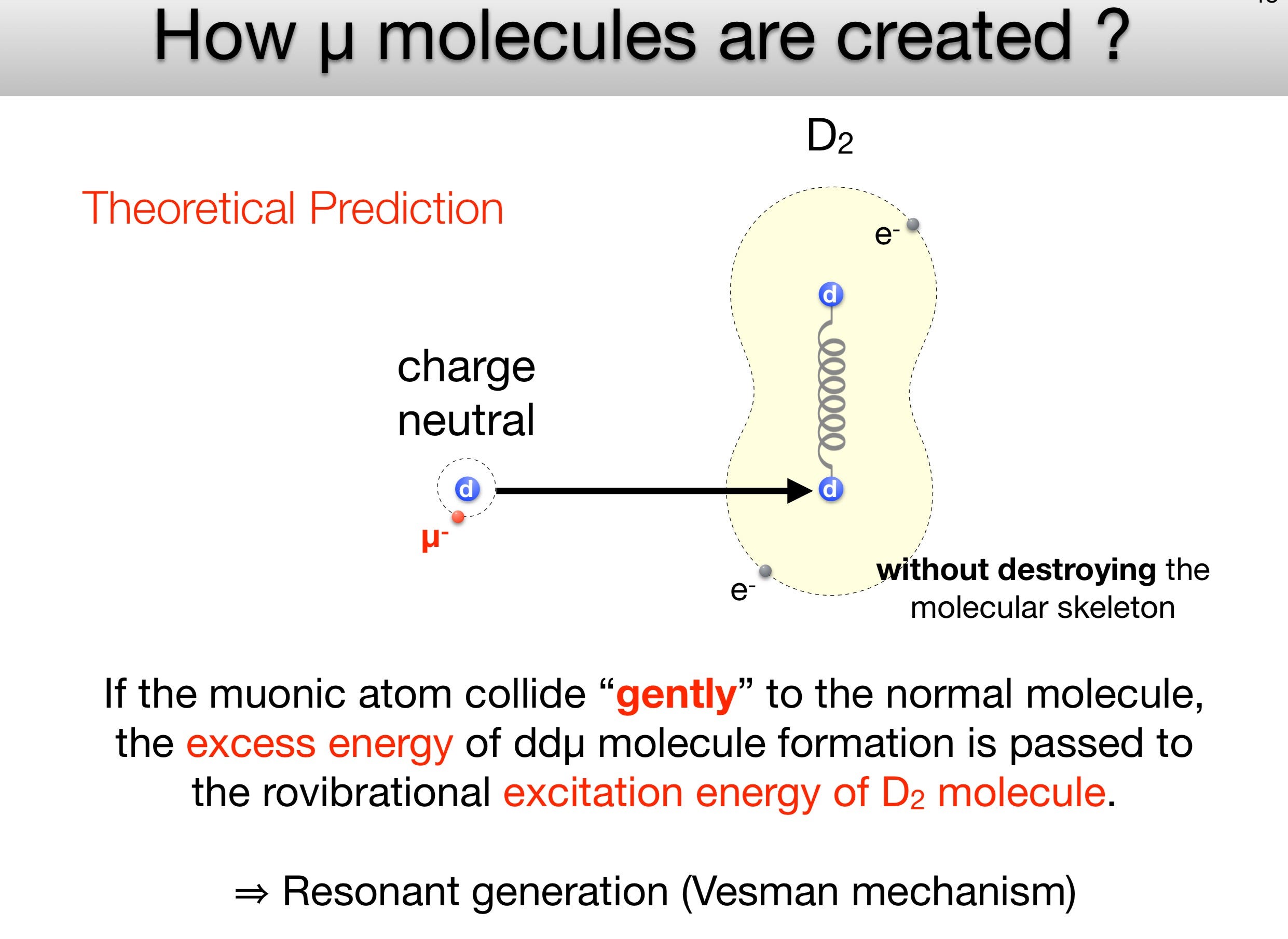
Next, Okada’s team turns these muonic atoms into molecules. They do so by ramming them into ordinary molecules made of two ordinary atoms of deuterium (D2). Each muonic atom captures one of the ordinary deuterium nuclei and assimilates it. The muon slips into orbit around both the original nucleus and the newly acquired nucleus, binding them together into a tiny molecule, the likes of which is not seen in nature.
The capture process releases energy and can proceed only if there is some way to dispose of it. “We need to give some energy to another system,” Okada said. One option is that the ordinary molecule falls apart, freeing one of its electrons to take up the energy. But its electrons are poorly positioned to assume this role and do so only with a low probability.
Fortunately, there is another pathway proposed by Estonian physicist Elmar Augustovich Vesman in 1967. The ordinary molecule can remain intact and absorb the energy by beginning to rotate and vibrate. That will occur within 10 nanoseconds and sometimes even faster. But now we have a strange situation. The ordinary molecule is still around, but one of the deuterium nuclei has been replaced by a muonic molecule. Thus a molecule lives inside another molecule—what Okada calls a “Matryoshka molecule.” Again, nothing like this happens outside a laboratory.
Within a picosecond, the two nuclei in the muonic molecule undergo fusion and turn into helium plus, if tritium is used, a neutron. The muon is typically ejected, freeing it to catalyze other fusion reactions before it dies, setting off a chain reaction.
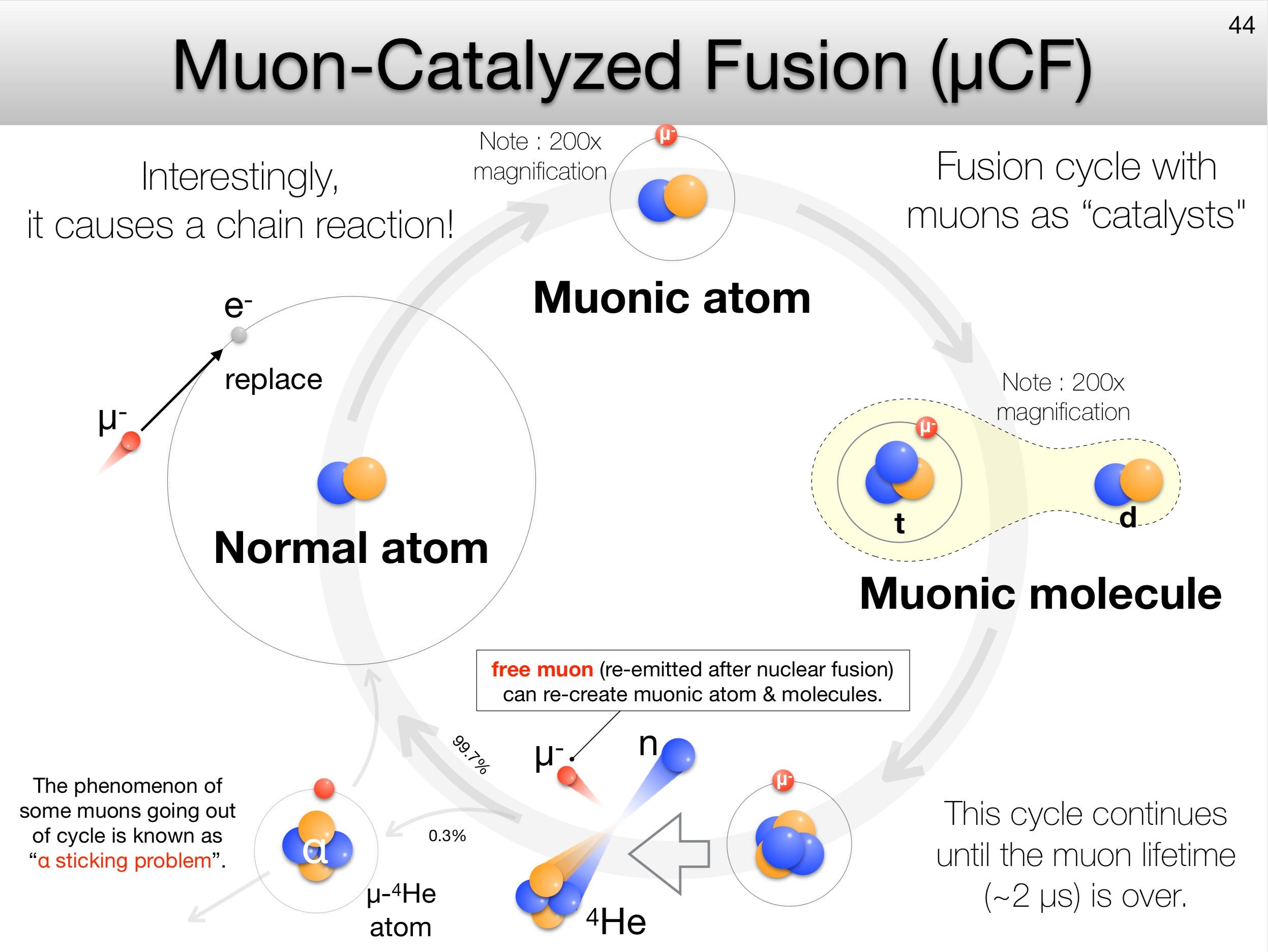
Reuse is crucial. Muons don’t come for free. It takes about the energy equivalent of five protons to make one, so the muon would have to catalyze at least 280 fusion reactions to pay that back, and probably many more once you account for various inefficiencies. That strikes theorists as unlikely because sometimes the helium clings on its muon and removes it from circulation. The sticking probability is calculated to be about 1 percent, which is low, but not low enough. Okada speculated that the helium might undergo collisions that shake the muon off, but this remains to be tested. A couple of companies are pursuing energy generation, and I haven’t talked to them yet, but none of their published materials indicate how they intend to surmount the sticking problem.
Even if you give up on energy generation, the neutrons can themselves be a valuable product. “I see opportunities to explore medical isotope production, irradiation testing of materials, and research on the transmutation of nuclear waste,” Okada said.
Mostly, muonic molecules are just plain cool. In experiments earlier this year, his team created some using deuterium. Under the conditions in their system, the molecules fell apart in a blaze of x-rays rather than fuse—which was good, because the team could measure those x-rays and reconstruct the molecular structure. “Previously, much of our information came from what emerged after fusion,” Okada said. “We can now probe the internal quantum states of molecules along the reaction pathway itself.”